Stop Brute-Forcing Intelligence: Why Contextual Memory Beats Predictive AI
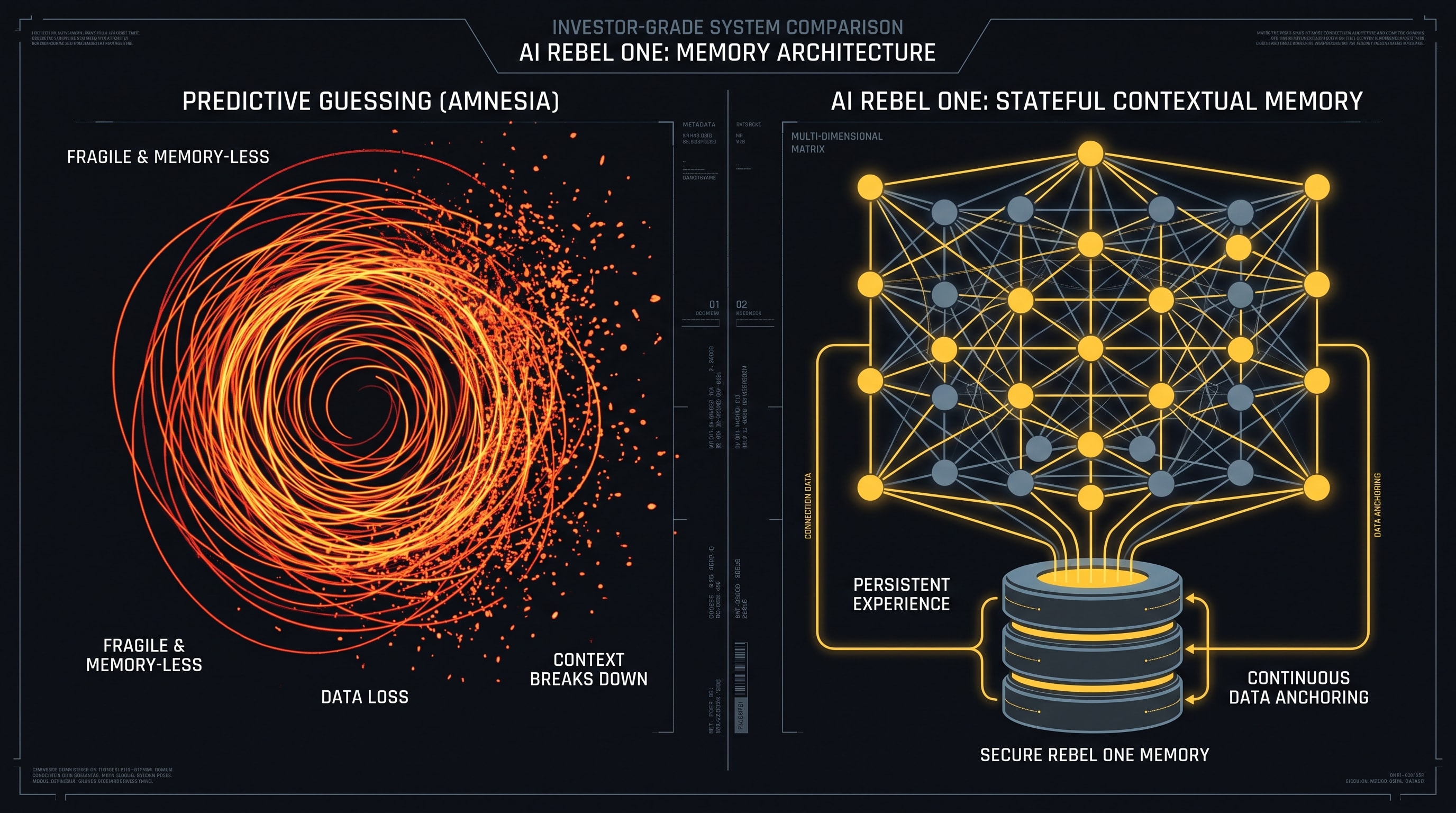
Throwing more compute at endless token scaling isn't solving the core problem — it's just burning energy to mask a structural design flaw. Real utility comes from stateful, persistent memory anchored to real data.
If you want an AI to finish the sentence "Mary had a little..." or help you look up a quick recipe, any basic chatbot will get you there. But if you're using AI regularly for work, developing ideas, running a business, or trying to cure cancer, you already know the frustration of having to repeat yourself over and over. When an AI can't properly handle large amounts of data, it goes off-kilter and starts to hallucinate.
My frustration with AI started long before I ever went into building these systems. I kept hitting the same wall with every model I tried: they just couldn't remember anything important. So what did I do? I painstakingly re-fed the memory the AI kept losing back into it, over and over, just so I could use it to help develop my own AI.
Along the way, I also ran into some very unsettling, misaligned systems, and I grew to utterly hate the trap of the current tech ecosystem: every brilliant idea or business strategy you develop with a public AI is quietly used to train the exact same model you and your competitors are renting.
That frustration is why we built AI Rebel One around stateful, persistent contextual memory from day one.
Think about what happens when you rely on standard prediction models. If an AI guesses how to handle a customer interaction without knowing your history, your past challenges, your wins, or your relationships, it can guide you down the wrong path with total, terrifying confidence.
It drops you straight into a costly, repetitive loop of hallucinations and ill-advised strategies. It wastes your time, and worse, it gives you bad advice when the stakes are high.
Throwing more brute-force compute at endless token scaling isn't solving this — it's just burning energy to mask a structural design flaw. Real utility doesn't come from a model that guesses better. It comes from a system with deep, secure memory anchored to real data where your information stays yours.
Stop guessing. Start remembering.
We currently have a working prototype and our Client Zero in active deployment, and we are actively looking for investors to scale this architecture. If you see the future of stateful AI, let's talk.
Explore Topics
Written by
René Bernatchez
Founder and Chief Architect of AI Rebel One Inc. René leads the design and development of Rebel One OS, a sovereign AI operating system built to solve the largest liabilities in commercial AI. Read more thought leadership in Intel.