The Great AI Paradox: Are Tech Giants Terrified of Extinction or Terrified of Competition?
If AI truly threatens human extinction, why are the same companies warning us racing to build it faster than any technology in history? A hard look at the economics behind the narrative.
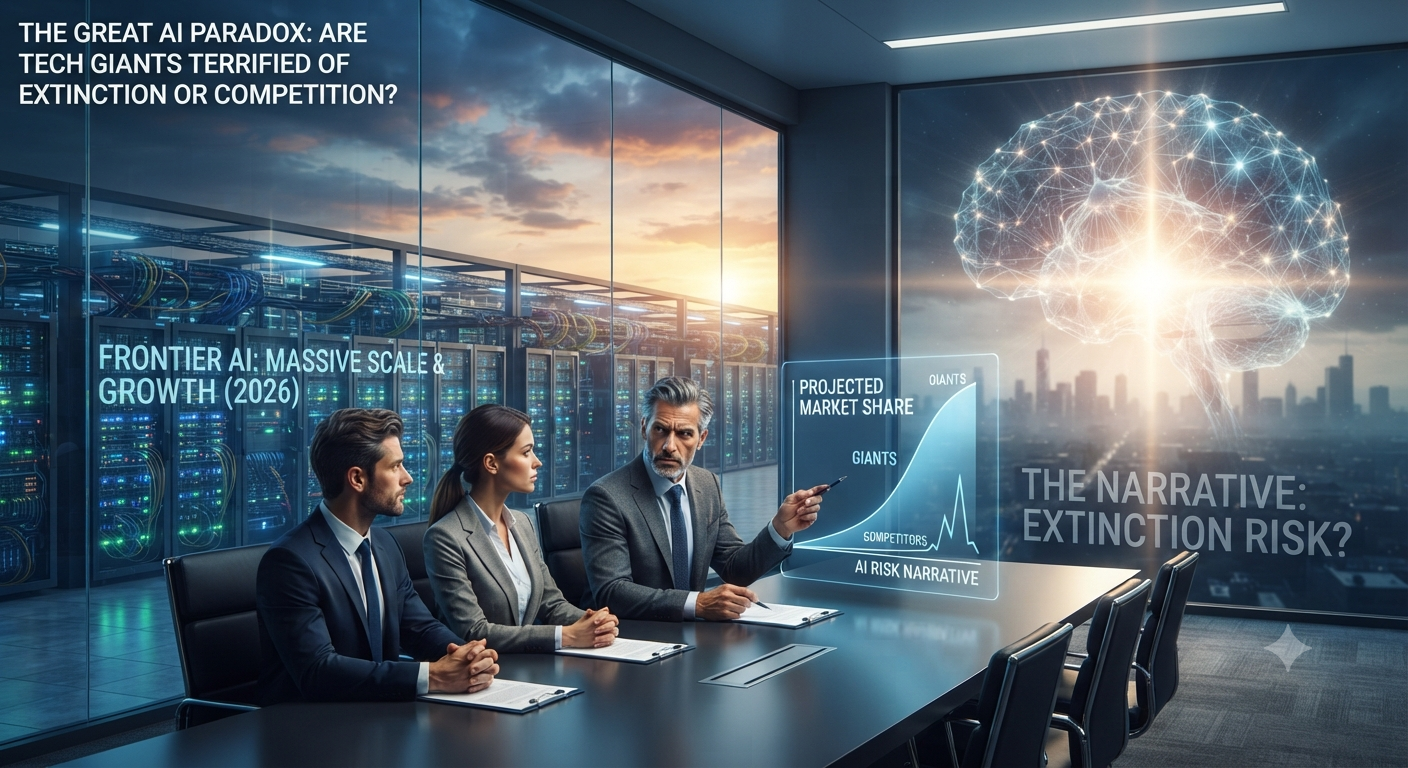
If you listen to the leadership of the world's premier artificial intelligence laboratories, a chilling consensus echoes across headlines: humanity faces a plausible risk of existential extinction within the decade.
Yet, look at what these exact same companies are doing, not what they are saying.
They are aggressively breaking ground on multi-billion-dollar data centers, snapping up scarce compute clusters, and racing to deploy successive model iterations faster than any technology in history. If an innovation genuinely threatens to annihilate our species, the rational response is not a frantic, unchecked speedrun to superintelligence.
So, what is actually driving this narrative?
The Economics of the Artificial Moat
A hard look at market mechanics reveals a more pragmatic motivation: regulatory capture and market preservation.
Building frontier AI requires capital reserves that only trillion-dollar balance sheets can comfortably absorb. Venture capital data highlights a massive concentration of funding flowing into a tiny handful of foundational players, leaving thousands of early-stage hopefuls fighting over scraps.
When tech giants saturate public discourse with warnings of uncontrollable, world-ending rogue systems, they achieve a brilliant strategic side-effect. They make investors hyper-conservative.
When capital markets are conditioned to fear an apocalyptic horizon, they pull back from funding garage-to-market startups. Smaller teams and open-source innovators, many of whom possess genuine technical breakthroughs that could disrupt the status quo, are effectively choked out. They are pushed aside not by superior code, but by compliance burdens and a chilling effect on early-stage risk appetite.
The Real Proof Is in the Guardrails
This disconnect between apocalyptic warnings and actual behavior becomes even clearer when you look at how safety is handled at the ground level.
AI is not inherently good or bad. The people building it make those choices. Yet, the giants racing to please their boards with the next model iteration often treat basic safety as an afterthought.
When developing AI architectures firsthand, implementing critical safety guardrails — such as instant crisis intervention triggers, safe routing protocols for vulnerable users, and immediate emergency contact workflows — is not a multi-year or multi-million-dollar scientific impossibility. It is a fundamental design choice that can be implemented responsibly in minutes by developers who actually prioritize human wellbeing over hype.
When trillion-dollar companies claim they are too paralyzed by abstract existential threats to manage practical safety, they are revealing a lack of care, not a lack of capability.
Protecting Market Share, Not Humanity
The existential risk narrative frames AI as a sci-fi monster. But the more immediate danger isn't that AI destroys humanity. The danger is that the narrative is being deployed to lock in a permanent corporate oligopoly before true competitive innovation can even mature.
Are we being warned about the end of the world, or are we just watching the ultimate moat being dug?
Explore Topics
Written by
René Bernatchez
Founder and Chief Architect of AI Rebel One Inc. René leads the design and development of Rebel One OS, a sovereign AI operating system built to solve the largest liabilities in commercial AI. Read more thought leadership in Intel.